Back to top

Lead Generation vs Appointment Setting: Key Differences for B2B Growth

Direct Answer: Lead Generation vs Appointment Setting B2B lead generation finds and verifies people who match an Ideal Customer Profile…

Lead Generation vs Appointment Setting: Key Differences for B2B Growth

4th November 2026

Direct Answer: Lead Generation vs Appointment Setting

B2B lead generation finds and verifies people who match an Ideal Customer Profile (ICP), then reaches out to build initial interest. Appointment setting picks up from there — turning an engaged, qualified prospect into a confirmed meeting on a calendar. Put simply: lead generation fills the top of the funnel with verified contacts and positive replies, and appointment setting handles everything in the middle — scheduling, objections, no-show prevention — so an actual discovery call happens.

Introduction

A company collects verified work emails, runs a cold email sequence, and gets fifty replies asking for more information. The marketing team logs these as “leads” and calls the week a win. Meanwhile, the account executives sit with empty calendars because no one followed up to handle scheduling objections or lock in specific time slots. By Friday, forty of those fifty hand-raisers have gone quiet.

This mismatch happens every day in B2B tech and service companies. Founders and sales leaders often treat lead generation and appointment setting as the same job, hiring a single SDR to handle data mining, copywriting, prospecting, objection handling, and calendar management all at once. When meetings stall, management usually blames the messaging or assumes cold outreach “doesn’t work.”

Filling a pipeline actually requires two distinct steps: finding the right people, and getting those people onto a discovery call. Mixing up these functions creates friction, wastes budget, and burns out reps.

What Is B2B Lead Generation?

B2B lead generation is market research fused with outbound communication — identifying accounts that match your Ideal Customer Profile (ICP), pulling accurate contact details for the people who actually make buying decisions, and getting the first message in front of them.

Buying a static list from a data broker isn’t lead generation, even though plenty of vendors sell it that way. Real lead generation runs on three layers working together.

What Does ICP Definition and Account Targeting Involve?

Narrowing the field by firmographics, tech stack, headcount changes, or recent funding — so reps stop wasting hours on accounts that were never going to buy.

How Does Data Sourcing and Verification Work?

Pulling contacts from tools like LinkedIn Sales Navigator, Apollo, or Crunchbase, then verifying every address before sending — so a bad list doesn’t tank deliverability.

What Happens During Initial Outreach?

Short, relevant messages by email or LinkedIn, built to test positioning and prompt a reply — not to close anything.

A lead generation campaign succeeds when it identifies real market interest. It doesn’t close deals, and it doesn’t always result in an immediate calendar invite — its job is to turn a cold database into a list of verified hand-raisers. As a reference point, SalesAR reports that mature B2B outbound campaigns typically land a reply rate between 10% and 18%, reflecting clean data and relevant targeting rather than volume alone.

What Is B2B Appointment Setting?

If lead generation creates initial curiosity, appointment setting turns that curiosity into a firm commitment on a sales rep’s calendar — everything that happens between a prospect saying “tell me more” and that same prospect actually showing up to a discovery call.

Appointment setting is a high-touch negotiation process, not an admin task. It has three moving parts, and skipping any one of them is usually where deals quietly die.

What Does Qualification Involve in Appointment Setting?

Checking positive replies against BANT (Budget, Authority, Need, Timeline) or a custom set of SQL (Sales-Qualified Lead) criteria that defines when a contact is actually ready for an Account Executive. A prospect who replies with interest but runs a 2-person team, when your minimum customer size is 50 employees, gets disqualified here — before they ever hit an AE’s calendar.

How Do Setters Handle Objections?

The same pushbacks come up again and again — “send over a deck first,” “we’re locked into a contract until Q4,” “is this a sales pitch?” — and a good setter has an answer ready for each one.

What Does Calendar Coordination Actually Cover?

Scheduling links instead of back-and-forth emails, confirmed meeting details, and reminders timed to keep no-shows down.

Skip dedicated appointment setting and up to half of all positive replies from cold outreach simply die in the inbox. People get busy. Priorities shift. Administrative friction kills momentum that took real effort to build.

Where Does Each Process Sit in the B2B Sales Funnel?

So where does the line actually fall? Here’s how these functions map onto a typical B2B buying journey:

Funnel Stage Owning Function Core Activities
Top of Funnel (ToFu) B2B Lead Generation ICP research and account mapping; email infrastructure setup and verification; cold email and LinkedIn messaging; initial response capture
Middle of Funnel (MoFu) B2B Appointment Setting Intent and SQL qualification; handling scheduling pushbacks; securing calendar invites; pre-call reminders and briefing
Bottom of Funnel (BoFu) Account Executives Running discovery calls and product demos; proposal delivery and value modeling; contract closing and account onboarding

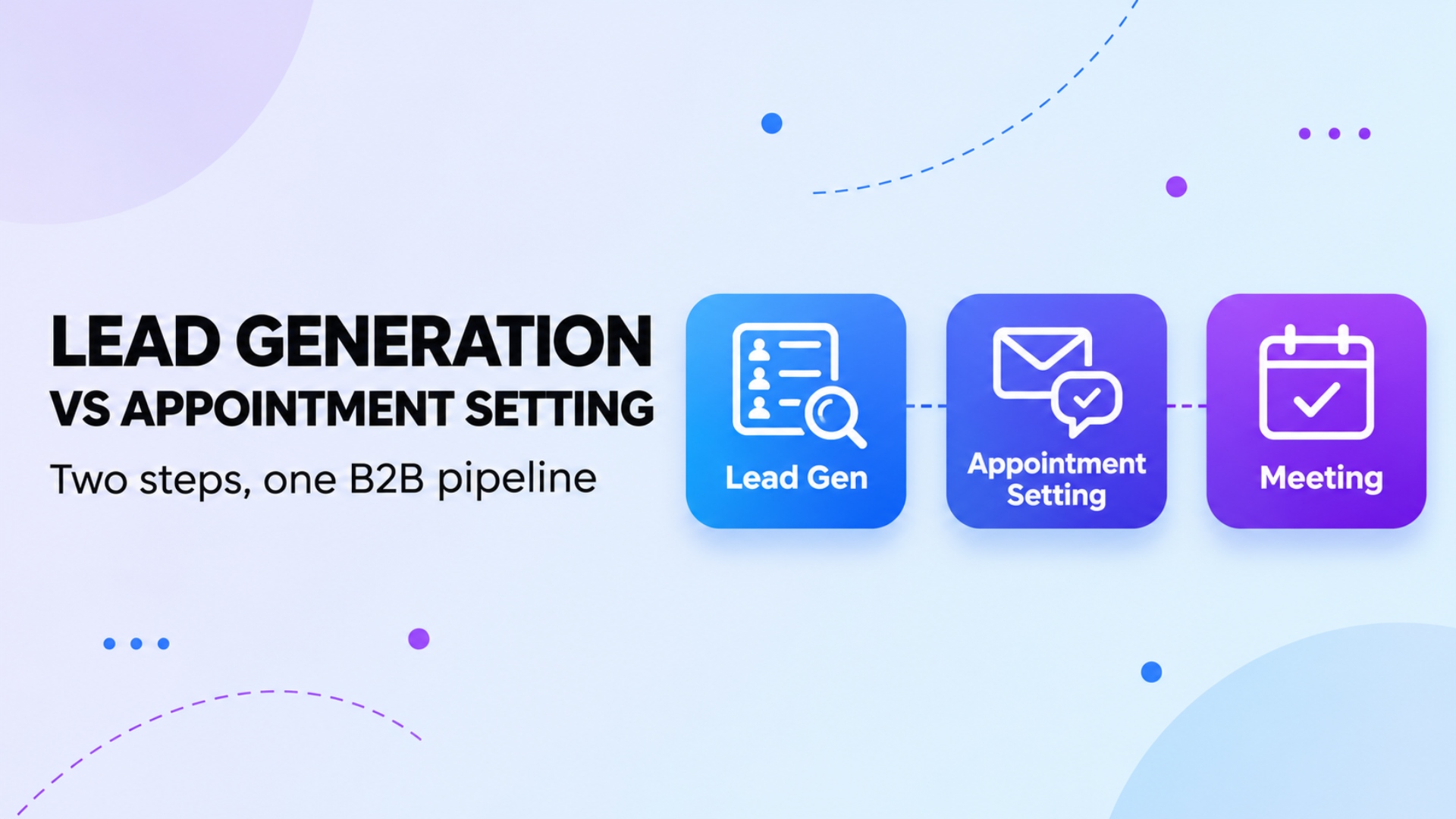
Lead generation owns the top, building awareness and capturing initial intent. Appointment setting owns the middle, turning that intent into a confirmed slot on a calendar. From there the Account Executive takes the meeting and runs it through to close.

What Are the Key Differences Between Lead Generation and Appointment Setting?

While both disciplines share the goal of growing revenue, their daily workflows, skill requirements, and metrics are completely different.

According to Salesforce’s 2026 State of Sales report, nearly half of sales reps (48%) say they lack the bandwidth to do adequate cold outreach, even though prospecting already consumes close to a full day of their workweek. Splitting research and outreach from qualification and scheduling is one of the few ways to recover that lost capacity without simply hiring more generalist reps.

Here is how the two functions compare side by side:

Metric / Attribute B2B Lead Generation B2B Appointment Setting
Primary Goal Build market awareness & find interested accounts Turn interested accounts into confirmed sales calls
Starting Input ICP parameters, verified domain infrastructure, cold data Positive email replies, form fills, hand-raisers
Final Output Clean contact lists & positive responses Confirmed calendar event with a qualified buyer
Funnel Stage Top of Funnel (ToFu) Middle of Funnel (MoFu)
Key Roles Data Researchers, Deliverability Engineers, Copywriters Sales Development Reps (SDRs), Appointment Setters
Core Tasks List cleaning, email warmup, cold sequence creation Qualification checks, email negotiation, reminder setups
Primary KPIs Inbox placement rate, open rate, positive reply rate Meeting booking rate, SQL rate, call show rate
Common Failures Spam folder placement, bad contact data, weak offers Slow reply times, weak objection handling, high no-shows
Business Value Opens new target accounts & tests messaging Maximises AE calendar capacity & pipeline velocity

Separate the two functions and pipeline problems get a lot easier to diagnose. No replies coming in? That’s a lead generation problem. Replies coming in but AE calendars still empty? That’s appointment setting. For a deeper breakdown of these dynamics, see SalesAR’s detailed comparison of lead generation and appointment setting, drawn from the team’s hands-on outbound work with B2B clients.

When Does a Company Need Only Lead Generation?

A few situations make a pure lead generation push the right call. Expanding into a new region or launching a new product tier is one — you need fresh data before more sales capacity, and a lead gen push validates open rates, reply rates, and buyer interest without dragging the whole sales team into unproven territory. Freeing up experienced SDRs is another: if reps who are good at booking meetings are instead burning half their week pulling contacts off LinkedIn, dedicated lead gen support gets them back to work that needs their judgment. And PLG companies selling low-friction software often skip sales calls entirely, using lead generation to drive free-trial signups or webinar registrations through automated onboarding instead of SDRs.

When Does a Company Need Only Appointment Setting?

Doubling down on appointment setting alone tends to work best in three situations:

  1. A stagnant CRM full of old leads. Most established B2B companies are sitting on thousands of past event leads, former opportunities, and dormant contacts in HubSpot or Salesforce. They don’t need new lists — they need setters working those cold records back into meetings.
  2. AEs drowning in admin. When senior reps spend hours emailing back and forth to confirm meeting times or chase lost replies, a dedicated appointment setting process hands them back their closing time almost immediately.
  3. Complex enterprise buying chains. High-ticket deals (ACV over $50k) need patient, human-led follow-up. Nobody books a $50k meeting from a single email link — it takes an experienced setter navigating objections and juggling multiple stakeholders’ calendars.

When Should Both Processes Work Together?

For most B2B SaaS, IT services, and agency models, running both as one connected system beats running either in isolation.

Speed is the main reason this combination works. A prospect who replies with interest is only warm for a short window. Chili Piper’s 2025 benchmark study of nearly 4 million form submissions (mostly B2B) found that instant, structured follow-up lifts meeting booking rates to 66.7%, compared to roughly 30% for standard, unassisted follow-up — more than double. Response speed is one of the strongest predictors of booking success. Route list building and outreach directly into a dedicated setter’s queue instead of a shared inbox, and response times drop while booking rates improve.

What Are the Most Common Mistakes When Combining Lead Generation and Appointment Setting?

Even experienced teams trip over the same handful of mistakes when they integrate ToFu and MoFu outreach — usually because the handoff between the two isn’t managed carefully.

1. Treating Every Reply as a Sales-Ready Lead

A prospect asking “Can you send a case study?” is expressing mild curiosity, not requesting a 30-minute sales demo. Pushing a calendar link on passive inquiries creates high no-show rates and annoys prospects. Setters must qualify intent before booking.

2. Failing to Pass Bad Data Insights Back to Research

Say an appointment setter notices that 30% of booked calls turn out to be under-budget companies — that feedback needs to go straight back to the data research team. Skip the weekly loop and outreach keeps burning email health on accounts that were never going to convert.

3. Running Without a Clear Response SLA

A positive reply sitting in an inbox over the weekend, or unhandled for six hours during a business day, is often enough to tank conversion. A strict Service Level Agreement covering response times, qualification standards, and no-show follow-up sequences fixes this.

How Should Lead Generation and Appointment Setting Change by Company Stage?

How you structure these functions depends heavily on your team’s current scale:

Organisational Stage Primary Priority Typical Setup
Early Startup (Pre-Series A / <$2M ARR) Finding market fit, testing messaging Founder or single SDR handles both lists and outreach
Growing SMB ($2M–$15M ARR) Volume with quality control Outsourced sales development team (research, outreach, and qualification) feeding in-house AEs
Enterprise ($15M+ ARR) ABM depth on named accounts Specialised pods: data team, deliverability engineers, senior setters

Numbers help, but sometimes a fast gut-check works just as well.

Quick diagnostic: lead generation, appointment setting, or both?

Answer in order and stop at the first “no” — that’s where to invest first.

  1. Is your CRM full of verified contacts matching your ICP? If not, that’s a lead generation gap.
  2. Are those contacts replying at a reasonable rate for your industry? Still lead generation if not — usually a messaging or deliverability issue rather than volume.
  3. Are positive replies qualified and followed up within hours, not days? A “no” here points to appointment setting.
  4. Do booked meetings actually show up and match your ICP? If they don’t, look at qualification standards or scheduling logistics inside appointment setting.

“Yes” to all four means the bottleneck sits downstream of both functions, in discovery-call execution rather than top-of-funnel volume.

Scenario A: Early-Stage B2B Startup

Budget is tight, the founder is still closing every deal personally, and messaging hasn’t been proven yet. Stay lean: source 150-200 hyper-targeted accounts a month and let the founder or first SDR handle both outreach and scheduling directly. That’s the fastest way to hear real market feedback firsthand.

Scenario B: Mid-Market Tech Company

Account Executives are spending too much time prospecting, and open pipeline deals are stalling as a result. Bringing in a dedicated external sales development team — one that handles research, outreach, reply handling, and qualification — lets four AEs spend their time on discovery calls and closing. The AEs give weekly feedback on meeting quality, and that feedback shapes which accounts get targeted next.

Scenario C: Enterprise Service Provider

When you’re selling $100k+ contracts into accounts with eight or more decision-makers, an Account-Based Marketing (ABM) structure beats a generic outbound motion. Lead gen teams handle account mapping and personalised multi-channel aircover; senior enterprise setters run tailored outreach to C-suite executives.

How Do You Make Lead Generation and Appointment Setting Work as One System?

Lead generation and appointment setting aren’t competing strategies. They’re two steps in the same pipeline: lead generation builds market visibility, validates contact data, and surfaces initial interest, while appointment setting does the human work of qualifying that interest and locking in real meetings.

Skip lead generation and reps end up working an empty list. Neglect appointment setting, and the inbox quietly fills with interest that never becomes a calendar event. Get both right, though, and cold prospects turn into pipeline on a schedule you can actually plan around.

Frequently Asked Questions (FAQ)

Is appointment setting part of lead generation?

Not quite — think of it as the sub-process that lead generation hands off to. Lead generation covers everything from initial market targeting to cold outreach; appointment setting picks up positive responses and turns them into confirmed calendar events.

Can lead generation work without appointment setting?

Sometimes. Self-service SaaS, e-commerce, and low-friction digital products can get by on lead generation alone. But for B2B deals with higher contract values and longer sales cycles, skipping structured appointment setting usually means high drop-off right after initial contact.

Which process should a B2B startup implement first?

Lead generation, almost always. Get the Ideal Customer Profile defined, test messaging, and build a clean contact list first — then bring in formal appointment setting workflows once cold outreach starts generating positive replies.

Who is responsible for appointment setting in a sales team?

Usually SDRs, BDRs, or a specialised appointment setting agency, depending on team size. Whoever owns it, their job is qualifying prospects and filling AE calendars — not closing deals.

How are lead generation and appointment setting metrics measured?

Different funnels, different numbers. Lead generation lives or dies by email deliverability, open rates, reply rates, and list accuracy. Appointment setting is judged on meeting booking rates, qualified meeting rates (SQLs), and call show rates.

Can one agency manage both lead generation and appointment setting?

Yes. Many B2B companies work with a dedicated external sales development team that runs one continuous program — from account research and outreach through reply handling, qualification, and booking meetings directly on the client’s calendar. The advantage is a single team accountable for meeting quality, instead of a handoff between two vendors where context gets lost.

Categories: Advice

Our awards

Discover Our Awards.

See Awards

You Might Also Like