Back to top

What Importers Commonly Get Wrong When Negotiating Supplier Credit with Chinese Exporters

Negotiating supplier credit often fails not because the importer lacks financial strength, nor because the Chinese supplier is being unreasonable,…

What Importers Commonly Get Wrong When Negotiating Supplier Credit with Chinese Exporters

10th November 2026

Negotiating supplier credit often fails not because the importer lacks financial strength, nor because the Chinese supplier is being unreasonable, but because deferred payment terms represent a substantial financial risk for the exporter. The supplier’s primary objective is to mitigate this exposure. To secure favorable terms, importers must present a unified, realistic proposal that directly addresses and aligns with the supplier’s risk management framework.

When navigating these complexities, an independent review by Axton Global can help identify blind spots in the negotiation strategy before they cause delays.

As a trade finance specialist at the firm notes: “A frequent pitfall we observe is importers treating supplier credit as a standard procurement checkbox rather than a risk management partnership. When an importer proactively provides a standardized financial package and a realistic volume forecast, they shift the dynamic from asking for a favor to proposing a structured business expansion.”

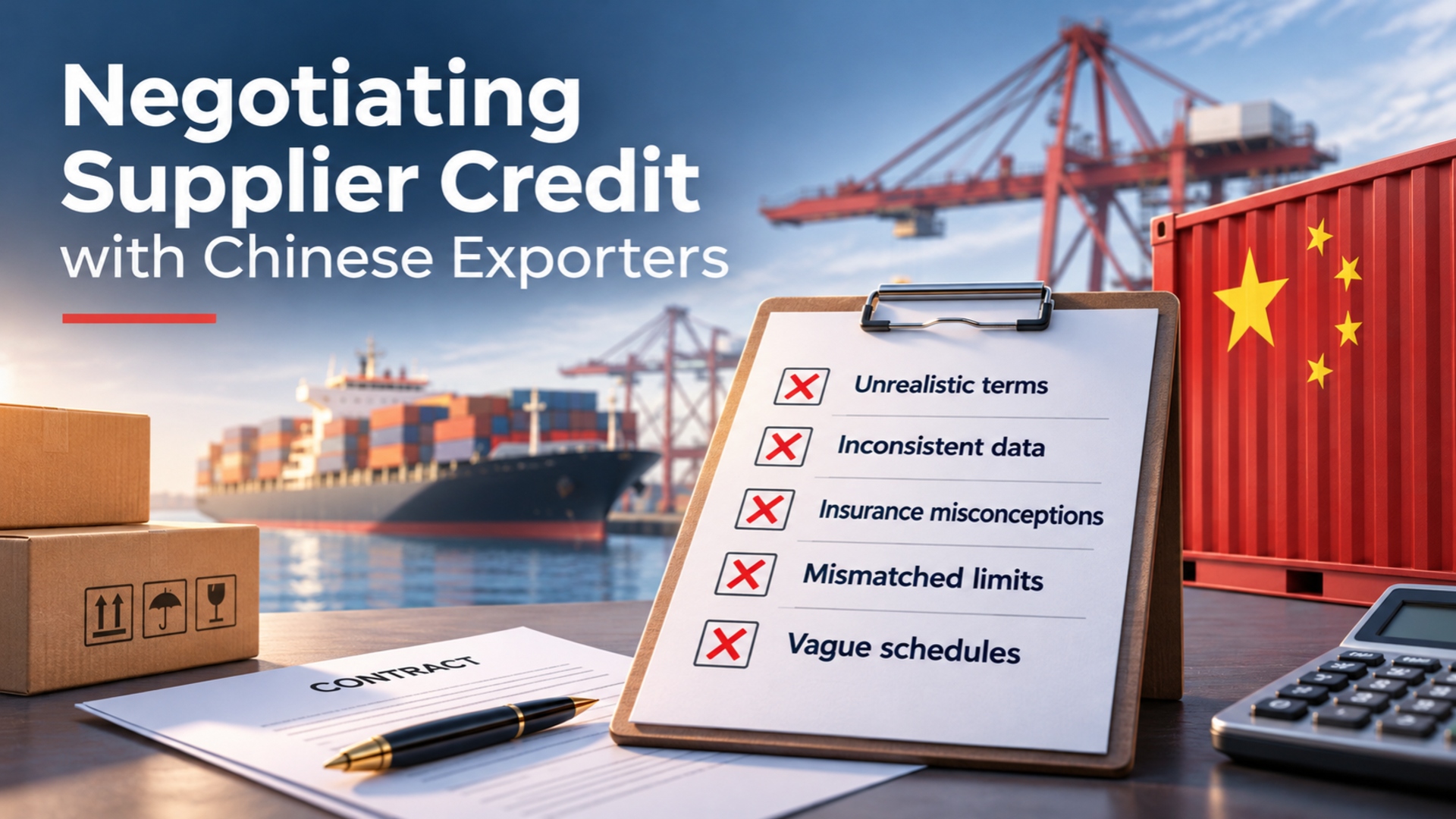
Mistake 1: Demanding Big Terms Without a Procurement Plan

The Error: Asking for Net-60 or Net-90 on a first-time or small-volume order without providing any broader business context. To a supplier, this looks like a high-risk demand.

The Fix: Propose a phased approach. Start by requesting a modest credit limit on standard terms (e.g., Net-30), backed by a documented 12-month procurement forecast. Showing a planned increase in order volumes proves the credit request is an investment in a scaling partnership, not just a short-term cash flow shortcut.

Mistake 2: Providing Inconsistent or Vague Business Information

The Error: Supplying different versions of financial statements, outdated bank references, or slightly varying company names across different supplier applications.

The Fix: Centralize and standardize all documentation. The exact legal entity name, registered address, and latest audited financials must be identical in every submission. Data consistency builds immediate credibility and stops underwriters from delaying the application to resolve perceived discrepancies.

Mistake 3: Misunderstanding Trade Credit Insurance and Credit Limits

The Error: Assuming that the China Export & Credit Insurance Corporation (SINOSURE) directly grants credit to the foreign buyer, or believing that an approved credit limit automatically guarantees a shipment or specific payment terms from the supplier.

The Fix: Understand the mechanics correctly. The Chinese exporter applies for trade credit insurance to mitigate their own risk. SINOSURE evaluates the foreign buyer to set a credit limit specifically for that supplier-buyer relationship. The importer’s role is to facilitate this assessment by providing transparent financial data, recognizing that the final decision on payment terms and shipment release ultimately rests with the supplier.

Mistake 4: Mismatching the Credit Limit and Transaction Reality

The Error: Requesting a credit limit that is wildly disproportionate to historical order sizes or the supplier’s known production capacity.

The Fix: Align the requested limit with actual, verifiable transaction data. If a company historically orders $50,000 per shipment, asking for a $500,000 limit requires a clear, documented justification, such as a newly signed distribution contract. Keeping requests proportional to demonstrated capacity prevents automatic risk flags.

Mistake 5: Leaving Delivery and Payment Schedules Ambiguous

The Error: Agreeing to “Net-60” verbally or in a brief email without defining the trigger date. This inevitably leads to disputes over whether the countdown starts from the invoice date, the Bill of Lading date, or the final warehouse delivery date.

The Fix: Explicitly define all timeline triggers in the formal sales contract. Specify the exact payment currency, the specific milestone that starts the payment countdown (e.g., “60 days from the Bill of Lading date”), and the required delivery documentation. Clarity prevents administrative delays and preserves mutual trust.

How Professional Coordination Structures Complex Negotiations

Structuring a multi-layered supplier credit request requires aligning the importer’s cash flow needs with the exporter’s risk tolerance. This is where professional coordination earns its keep. An independent consultant can review the importer’s financial presentation, ensure alignment with trade credit insurance requirements, and help structure a phased negotiation strategy. This external perspective ensures that the importer’s request appears logical, well-documented, and low-risk to the Chinese exporter, significantly smoothing the approval process and preventing common procedural errors.

Conclusion

Negotiating supplier credit is a structured commercial process that depends heavily on preparation and transparency. By avoiding common pitfalls — such as mismatched limits, vague documentation, and unrealistic term requests — importers can present a strong, credible profile. A coordinated, step-by-step approach not only prevents unnecessary scrutiny from underwriters but also builds the foundation for sustainable, scalable partnerships with Chinese exporters.

Categories: Logistics

Our awards

Discover Our Awards.

See Awards

You Might Also Like