Back to top

Why Data Teams Are Moving to Unlimited-Bandwidth Proxy Plans

For years, buying proxy access for web data work followed one simple rule. You paid for every gigabyte that crossed…

Why Data Teams Are Moving to Unlimited-Bandwidth Proxy Plans

9th November 2026

For years, buying proxy access for web data work followed one simple rule. You paid for every gigabyte that crossed the connection. That worked when data collection was a side project with a modest monthly bill. For many companies, it is now a core operation feeding pricing, market research and AI models.

The metered model is starting to strain under that load. Many data teams are now weighing flat-rate plans that drop the gigabyte meter entirely. Their reasons have less to do with engineering than with budgets, planning and how people behave when every page has a price.

The problem with paying by the gigabyte

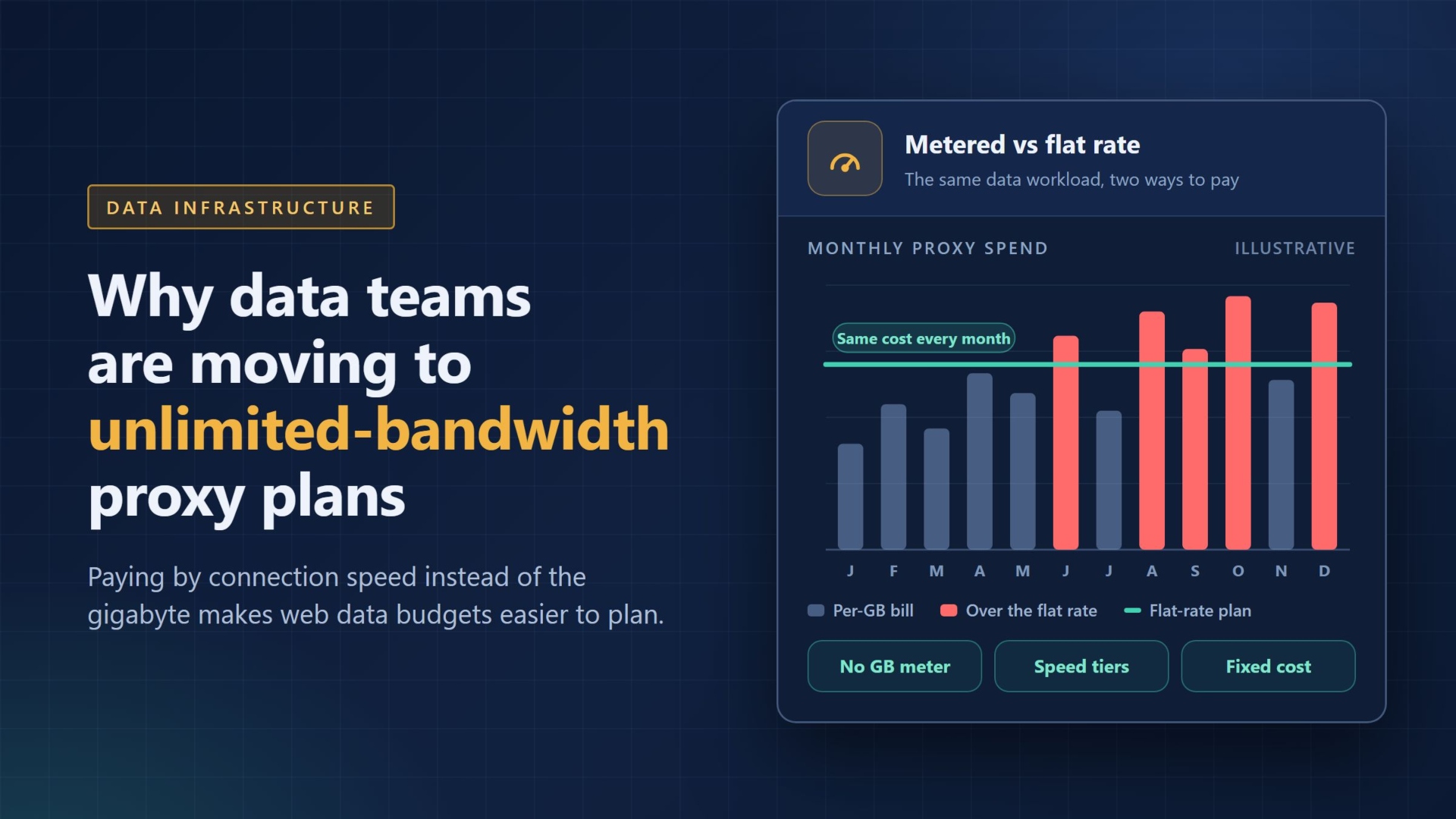
A per-gigabyte bill depends on things that are hard to forecast. Page weight changes when a target site redesigns or adds video. A new market, a higher refresh rate or a switch to browser rendering can multiply traffic quickly. None of these show up in a budget drafted months earlier.

For finance teams, that makes data collection an awkward line item. It looks like a utility but behaves like a variable cost tied to decisions made elsewhere. Leaders end up approving extra spend mid-month, or learning about an overrun when the invoice arrives.

Rationing is the hidden cost

Metered pricing also shapes behaviour, usually quietly. Engineers start rationing. They refresh prices weekly instead of daily and sample a few categories instead of the whole catalogue. Some markets get skipped because they look expensive to crawl.

Some of that discipline is healthy, and lean requests are good engineering on any plan. But when cost decides coverage, the business gets thinner data than it asked for. A pricing team watching half its competitors is making decisions with one eye closed.

What a flat-rate plan changes

Plans that offer residential proxies with no bandwidth cap usually price access by connection speed rather than volume. You choose a throughput tier, and the gigabytes moved within it are not counted. The cost is known before the work starts, which is what a budget owner wants.

The question stops being how much data the team can afford. It becomes how fast the team needs it, which is a far easier conversation between engineering and finance. Daily or weekly terms, which some providers offer, also let a team trial a project before committing to a month.

Where unlimited plans fall short

Flat-rate access is not the right answer for everyone. Unlimited plans often limit targeting to country level, so city or ISP-level work may still need a metered plan. The IP pool may also be smaller or separate from a provider’s main network. Results from one product won’t automatically carry over to the other.

Utilisation matters too. A flat fee pays off only when the connection stays busy. A small or occasional project may be cheaper on a metered plan. And “unlimited” refers to the gigabytes, not the performance. Throughput is still capped by the tier you choose.

Questions to ask before switching

A sensible evaluation takes a few weeks, not a quarter. Before moving any budget, put these questions to the providers on your shortlist:

  • What is our real monthly volume? Estimate the gigabytes your current projects move, then compare that metered cost with the flat fee for the tier you would need.
  • Is the pool deep in our markets? Ask for figures on the specific countries you care about, not just a global total.
  • Which rotation modes are available? Most collection jobs suit a new IP per request, but some need sticky sessions that hold one address for a while.
  • How does it perform on our targets? Ask for a short trial and test it on the sites you actually collect from, measuring success rate and speed.
  • Can we change tiers later? Check whether you can move up or down a speed tier as projects change, and how much notice that takes.

The bigger shift

The move to unlimited plans reflects how web data has changed inside companies. It used to be an experiment run by one engineer with a company card. Now it often feeds pricing engines, market intelligence and AI models that leadership relies on every day.

Infrastructure that important deserves a cost model the business can plan around. For high-volume work where country targeting is enough, a flat-rate plan is often the simpler choice. For precise local work, the meter may still earn its place, and plenty of teams may sensibly run both.

Categories: Tech

Our awards

Discover Our Awards.

See Awards

You Might Also Like