Back to top

Case Study: How a Specialist Manufacturer Built Its Strategy Around B2B Customer Pain Points

In specialist B2B markets, companies often describe their offer by listing everything they can produce. Customers, however, rarely buy capabilities…

Case Study: How a Specialist Manufacturer Built Its Strategy Around B2B Customer Pain Points

3rd August 2026

In specialist B2B markets, companies often describe their offer by listing everything they can produce. Customers, however, rarely buy capabilities in isolation. They buy solutions to commercial problems.

This case study examines how Marmorin, a Polish B2B manufacturer of bathroom fixtures and kitchen sinks, shaped its offer around the needs of brands, retailers, distributors and project clients.

Its strategic challenge was to organise strong manufacturing, design and product-development capabilities around how customers actually buy.

Rather than promoting production capacity alone, Marmorin focused on four recurring pain points: customers needed different routes to market, wanted to reduce the risk of testing new products, required meaningful product differentiation and needed help selling what they sourced.

A stronger proposition does not always require a new product or business unit. It may come from connecting existing strengths to the problems customers most want solved.

Build the offer around different buying situations

Marmorin recognised that not every B2B customer approaches a manufacturer with the same brief.

A retailer may want to add an existing product quickly. A bathroom brand may already own a design and need a factory to produce it. Another client may want to modify an available model, while a business seeking stronger differentiation may require a completely new product.

Treating all these customers as if they needed one standard service would create friction and could force them to change suppliers as their requirements evolved.

Marmorin therefore organised its offer around several cooperation models. Private label provides access to ready-developed products. ODM allows clients to adapt existing designs. OEM supports production from customer-owned specifications, while custom development covers projects that begin with an idea rather than a finished technical design.

They are different routes to the same outcome: helping customers bring suitable products to market.

This structure also supports longer relationships. A client can begin with a ready-made model and later move towards a more exclusive collection without replacing its manufacturing partner.

Reduce the risk of testing a new opportunity

Launching a product line requires confidence, but demand is rarely certain before the product reaches the market.

This creates a difficult choice for brands and retailers. A promising opportunity may become unattractive when a manufacturer requires a large opening order. High minimum quantities tie up capital, increase storage needs and make a poor product decision more expensive.

Marmorin addressed this by treating flexibility as part of its value proposition. In selected cooperation models, customers can begin without a fixed minimum order quantity, test products in their own market and increase volumes when demand becomes clearer.

Smaller orders may be less efficient for the factory, but Marmorin considers that cost against the potential lifetime value of the relationship.

The principle applies beyond sanitary ware. A strong product may still be difficult to buy if the customer must accept too much risk at the beginning.

By lowering that barrier, a manufacturer can make an opportunity easier to approve and create room for future growth.

Specialise where a capability solves a painful problem

Manufacturers often assume that a wider offer creates a stronger market position. In practice, excessive breadth can make it harder for customers to understand what makes a company distinctive.

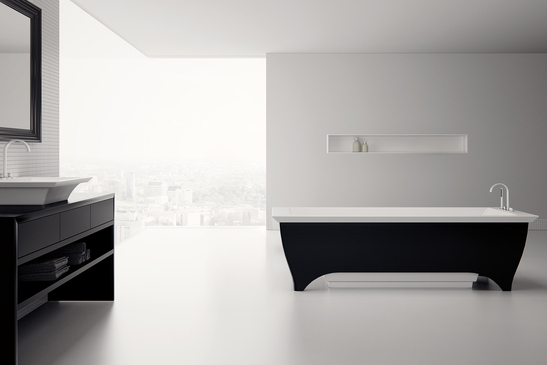
Marmorin chose to focus heavily on fixtures made from a dolomite-based mineral composite. Its strategic value lies in what it allows customers to offer their own market.

Brands, retailers and hospitality clients serving the upper end of the market need products that combine visual appeal with long-term performance. The material supports substantial, design-led fixtures with smooth finishes, durability and practical benefits that can be translated into clear sales arguments.

“Dolomite stone addresses a major problem for our customers. It is highly durable and, with the right finishing capabilities, creates the impression premium buyers expect. Those qualities already solved a clear headache for our clients, so there was little need to look beyond them,” says Agnieszka Maliszewska, Marmorin’s Chief Sales Officer.

The lesson is that specialisation becomes strategically powerful when it answers a commercially important need. The objective is not simply to possess a technical capability, but to show how it makes the customer’s product easier to position and sell.

Help customers generate revenue after production

Marmorin’s final strategic decision was to look beyond manufacturing.

A B2B customer still has work to do after receiving the products. Retailers must present them in catalogues and showrooms. Brands need convincing website and advertising messages. Salespeople must explain why one fixture is worth more than a cheaper alternative.

Generic statements such as “premium quality” are rarely enough. Commercial teams need specific arguments related to design, durability, maintenance, repairability, comfort and safety.

Because Marmorin works exclusively with business customers, it can support this next stage. Product knowledge, technical explanations and training help clients turn manufacturing features into messages their own customers understand.

This changes the supplier’s role. It is no longer responsible only for producing an item correctly. It also helps the customer realise the commercial value of that item.

For niche manufacturers, this can be a major differentiator. A supplier that strengthens the customer’s sales process may become more valuable than one offering similar production capabilities alone.

The strategic lesson

Marmorin’s case illustrates a practical approach to offer development: start with customer pain, then identify which existing capabilities can remove it.

The company aligned its cooperation models with different buying situations, reduced the risk of market testing, focused on a material with clear commercial value and extended support beyond the factory.

None of these decisions required abandoning its core business. The strategy came from making that core business more relevant to the customers it wanted to serve.

For other specialist B2B companies, the key question is not simply, “What can we offer?” It is, “Which of our strengths solves the problems our target customers care about most?”

Categories: Advice

Our awards

Discover Our Awards.

See Awards

You Might Also Like