Back to top

How Warehouses Are Replacing Manual Device Check-Outs with Automated Locker Systems

The first minutes of a warehouse shift are operationally expensive. Pickers, forklift operators, packers, supervisors, and inventory teams need handheld…

How Warehouses Are Replacing Manual Device Check-Outs with Automated Locker Systems

4th June 2026

The first minutes of a warehouse shift are operationally expensive. Pickers, forklift operators, packers, supervisors, and inventory teams need handheld scanners, radios, rugged tablets, or other shared devices before work can begin. If those devices are behind a supervisor’s desk, buried in a charging cabinet, or tracked on a paper sign-out sheet, the line forms quickly.

The delay is not just inconvenience. A slow handoff can push back shift starts. A missing scanner can leave a worker waiting. A paper log can show that a device should have been returned without proving who last had it. In high-volume logistics environments, that creates a chain-of-custody problem.

Automated locker systems address the operational gap by turning device checkout into a controlled, self-service workflow.

Why Manual Device Sign-Out Breaks Down in Warehouse Environments

Manual checkout processes often work when the device fleet is small, the team is stable, and the pace is predictable. Warehouses and distribution centers rarely operate that way.

Paper Logs Are Easy to Ignore

A sign-out sheet depends on every worker writing down the right device, time, and name during a busy shift change. That process breaks down when people are rushing, when pens disappear, when the sheet is incomplete, or when supervisors have more urgent problems to solve.

Supervisor Gatekeeping Creates Queues

If a supervisor controls access to devices, the supervisor becomes the bottleneck. Workers wait for equipment, while supervisors spend shift-start minutes distributing assets instead of managing labor, safety, exceptions, or throughput.

Shift Changes Compress Demand

Device demand is not evenly distributed throughout the day. It spikes when one shift ends and another begins. A manual process that seems acceptable at noon can fail at 6 a.m. or 10 p.m.

Chain of Custody Is Incomplete

If a handheld scanner goes missing, operations leaders need to know who last checked it out, whether it was returned, and where the process failed. Manual logs often provide partial records, especially when shared devices move quickly between workers.

Replacement Spend Has No Attribution Data

The cost of a missing device is not only the replacement unit. It includes downtime, troubleshooting, supervisor time, IT time, and the risk of understocking spare devices. Without attribution data, teams may know devices are disappearing but not why.

MHI and Deloitte’s 2025 Annual Industry Report found that 55% of supply chain leaders were increasing technology and innovation investment, with 60% planning to spend more than $1 million. The report also identified rising adoption across sensors and automatic identification, robotics, AI, IoT, and wearable/mobile technology. In that context, device handoff processes should not remain dependent on paper records.

How Automated Warehouse Device Locker Systems Work

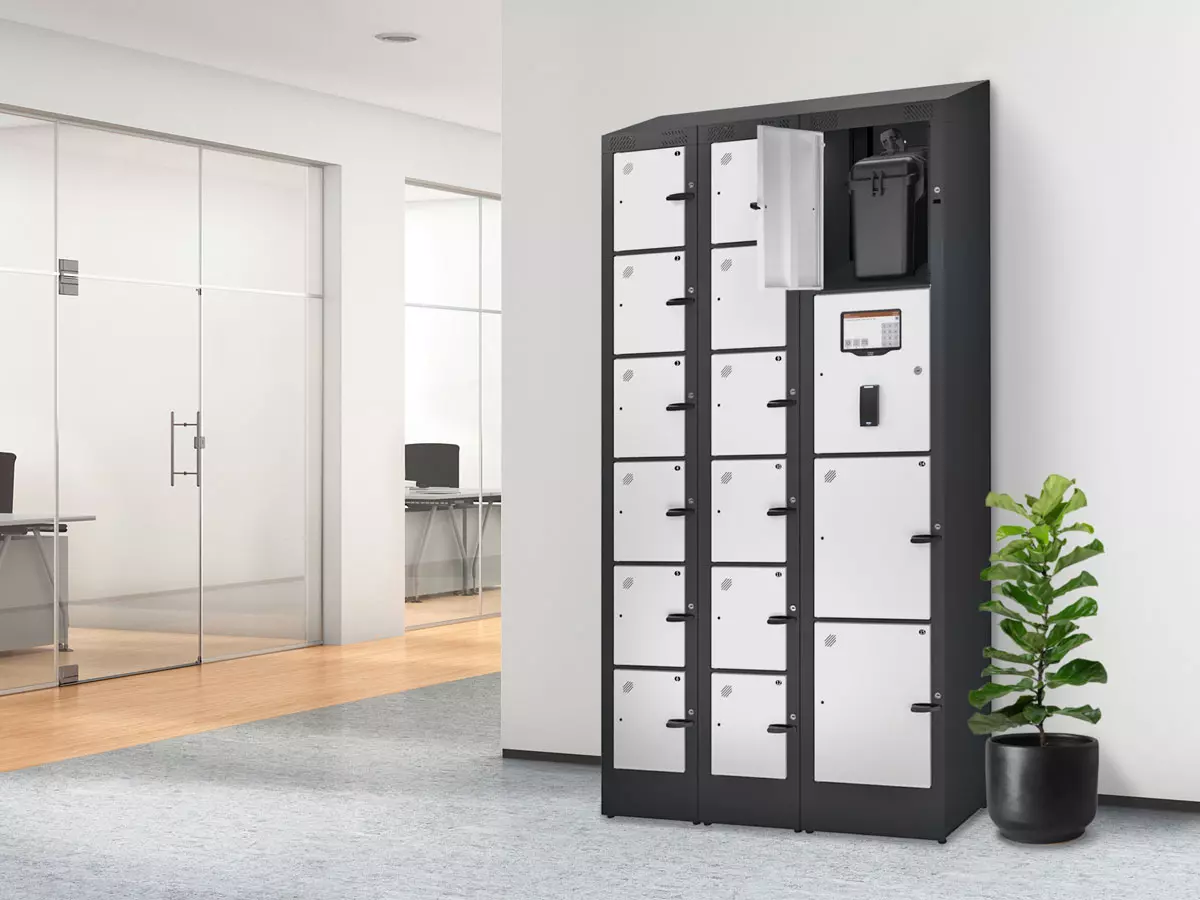
An automated device locker warehouse workflow replaces the manual counter handoff with a controlled access point. Workers authenticate, collect a device, perform their shift, and return the device when work is complete.

A typical process has five steps.

1. Worker Authentication

The worker signs in at the locker using a badge, PIN, mobile credential, or other approved identity method. The system verifies access based on role, shift, zone, or device type.

2. Device Pickup

The locker opens an assigned bay or an available bay containing the correct device. A picker may receive a scanner. A maintenance worker may receive a radio. A supervisor may receive a tablet.

3. Transaction Logging

The pickup is logged automatically. The record includes user identity, time, bay, and device association where configured.

4. Charging Between Shifts

When the device is returned, the locker can recharge it before the next shift. This helps reduce the common problem of devices being present but not ready.

5. Return and Audit Trail

At the end of the shift, the worker returns the device to the locker. The return is time-stamped, and the system updates device availability.

When operations teams evaluate a warehouse device locker system, they should look for shift-change workflow support, automatic charging, remote IT management, IT/OT integration options, and a reliable audit trail.

This is not the same as adding a locked cabinet to the floor. The point is to capture the transaction data that paper logs miss.

What Warehouses Gain from Automation

1. Shift-Change Speed

A shift device check-out locker can reduce lines because workers self-serve through a controlled process. Instead of waiting for a supervisor to issue devices one by one, approved workers collect equipment directly.

2. Chain-of-Custody Accountability

Every pickup and return can be tied to a worker ID. That gives operations, IT, and loss-prevention teams a clearer record of device movement.

3. Device Availability

Shared handhelds are only useful when they are ready at the start of the shift. Charging lockers help ensure devices are not left in drawers, offices, vehicles, or unpowered storage locations.

4. Loss Reduction

Last-known-custody data closes the attribution gap. If a scanner is missing, the team can see the last recorded user and return status. That does not eliminate every loss, but it improves investigation and accountability.

5. Reduced Supervisor Gatekeeping

Supervisors should not spend the start of every shift acting as equipment clerks. A smart locker for warehouses allows workers to collect approved devices while supervisors focus on floor execution.

Inbound Logistics describes warehouse automation as a response to rising demand, tighter delivery windows, and labor shortages, with technology changing how warehouse tasks are performed. Device access automation fits that broader pattern: it removes a repetitive manual task from the shift-start process.

Conclusion

Warehouses are replacing paper sign-out sheets and supervisor-controlled device closets because manual checkout does not scale well during shift changes. Automated locker systems create a repeatable process for authenticating workers, issuing shared devices, charging equipment between shifts, and recording every pickup and return.

The main benefit is not secure storage alone. It is accountability data. Operations teams gain a clearer view of who has which device, when it was collected, whether it came back, and how long it was in use. In a high-volume warehouse, that visibility can be the difference between a controlled shared-device program and a recurring shift-start bottleneck.

Categories: Tech

Our awards

Discover Our Awards.

See Awards

You Might Also Like