Back to top

Route Planning as a Strategic Lever in Procurement

Route Planning as a Strategic Lever in Procurement Procurement professionals juggle more than contracts and cost-savings — they coordinate supplier…

Route Planning as a Strategic Lever in Procurement

8th September 2025

Route Planning as a Strategic Lever in Procurement

Procurement professionals juggle more than contracts and cost-savings — they coordinate supplier audits, warehouse inspections, and urgent pickups across regions. When travel becomes routine, unplanned time and back-and-forth routes translate into wasted hours and inflated budgets. A smart route planner isn’t just a convenience — it’s a strategic tool that transforms scattered stops into streamlined, cost-effective operations. With interactive maps for route planning, your team can act decisively, optimize resource use, and contribute to key performance metrics.

Why Route Planning Matters for Procurement Now

  • Budgets are shrinking, supplier expectations are rising, and sustainability goals are non-negotiable.
  • Even a few inefficient trips a week compound into substantial fuel costs and CO₂ emissions.
  • Optimized routes mean lower costs, smoother supplier engagement, and measurable ESG performance.

In short, route planning brings clarity, control, and measurable gains to a domain long considered peripheral.

Five Immediate Benefits for Procurement Teams

1. Smarter Supplier Rounds

Need to visit multiple sites in a day? A route planner sequences logistics by geography, traffic, and opening hours, avoiding double-backing and late arrivals.

2. Cost and Sustainability Gains

Cut miles, fuel, and carbon. Track per-trip metrics to feed ESG dashboards and show how procurement contributes to greener operations.

3. Live Agility

Procurement isn’t static. Shipments run late, supplier issues pop up unexpectedly. A good planner recalculates routes mid-day, keeps teams on track, and maintains SLAs.

4. Real Insights, Not Assumptions

Tools that record dwell times, idle delays, and turnaround performance shine a light on process inefficiencies — like paperwork or gate wait times — and equip you to drive real improvements.

5. One Truth for All Teams

Whether category managers, field agents, carriers, or finance — maps for route planning provide a shared, accurate roadmap. Everyone sees the same plan, reducing miscommunications and redundant coordination.

Key Capabilities to Watch In a Route Planner

  • Time-window support to align with dock schedules or supplier visiting hours
  • Dynamic road data incorporating live traffic and restrictions — not just point-to-point distances
  • Mobile-first workflows for photo capture, proof-of-visit, and live notes
  • Territory and workload balancing across teams or regions
  • CRM/ERP sync to automatically import addresses, orders, contacts
  • What-if scenario tools to simulate cost vs. service before locking in a plan

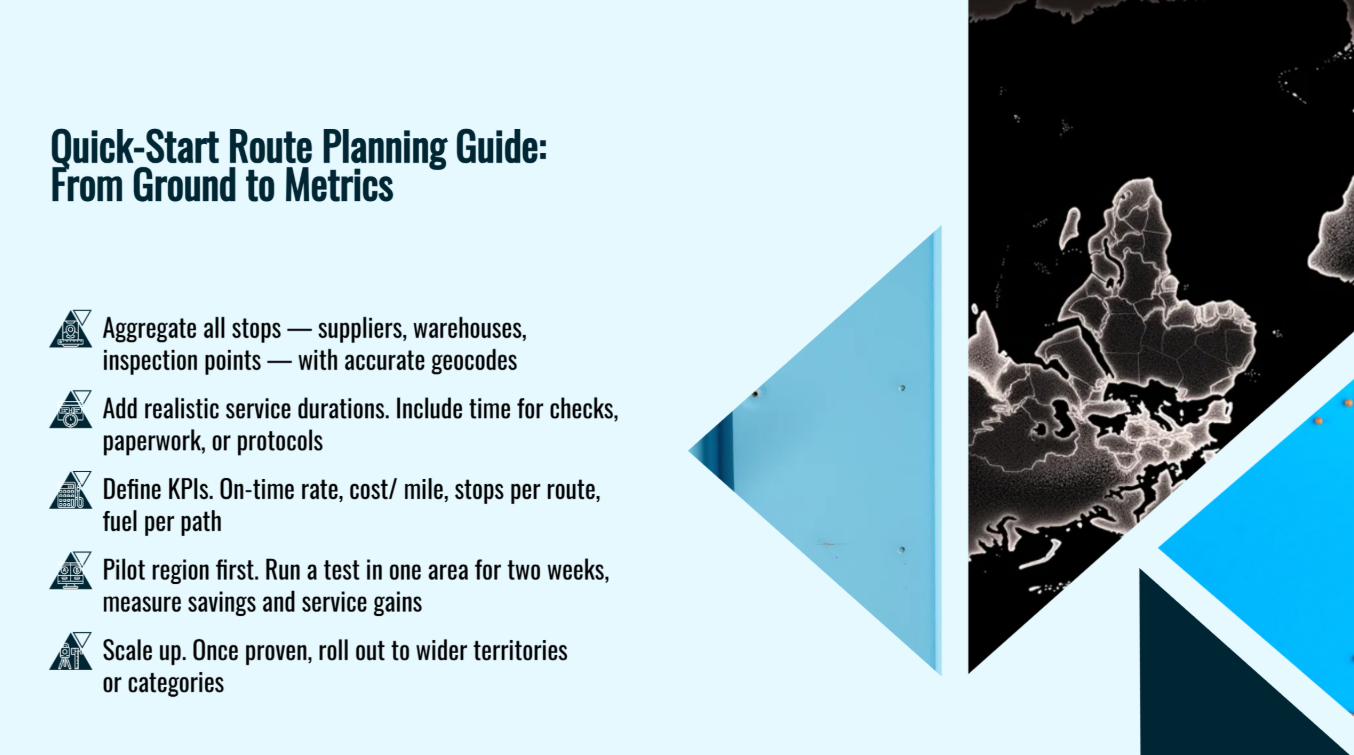
Quick-Start Route Planning Guide: From Ground to Metrics

  1. Aggregate all stops — suppliers, warehouses, inspection points — with accurate geocodes.
  2. Add realistic service durations. Include time for checks, paperwork, or protocols.
  3. Define KPIs. On-time rate, cost/mile, stops per route, fuel per path.
  4. Pilot region first. Run a test in one area for 2 weeks, measure savings and service gains.
  5. Scale up. Once proven, roll out to wider territories or categories.

If you’re exploring practical route planner options, consider a hands-on pilot with a tool like Mapsly’s route planning solution. It enables procurement and field teams to plan and optimize traveling routes directly within a CRM environment — making planning a route easy, integrated, and effective.

Conclusion: Route Planning — The Overlooked Backbone of Procurement Strategy

Procurement teams rightly focus on contracts, supplier quality, and cost efficiencies. Yet the execution — the travel between these activities — can either reinforce or undermine that strategy. A thoughtfully optimized engine of route planning conserves resources, enhances supplier trust through punctuality, and delivers tangible sustainability dividends.

Choosing the right maps for route planning elevates procurement from reactive sending of teams to a polished, data-driven, efficient operation. When every trip matters, route planning becomes not just a tactical tool, but a strategic advantage.

Categories: Advice, Articles, Logistics

Discover Our Awards.

See Awards

You Might Also Like