Back to top

Seedance 2.5 Review: Unleashing Longer-Form Creativity in AI Video

For most of the last product cycle, AI video felt impressive and incomplete at the same time. Tools could deliver…

Seedance 2.5 Review: Unleashing Longer-Form Creativity in AI Video

13th August 2026

For most of the last product cycle, AI video felt impressive and incomplete at the same time. Tools could deliver a striking five-to-fifteen-second moment — a product spin, a face turn, a cinematic flare — then stop before the idea had room to land. Marketing teams stitched fragments. Educators cut explainers into awkward chapters. Brand storytellers hoped the edit would hide what generation could not finish.

That is the gap a longer multimodal model is meant to close. This review looks at how Seedance 2.5 approaches next-gen AI video generation for creators who need a coherent clip up to about thirty seconds, not another orphan highlight reel.

What “next-gen” should mean in 2026

Novelty filters and one-click effects still have a place for social experiments. Production teams ask different questions:

  • Can one pass carry setup, development, and payoff?
  • Can references lock a product, person, or place across camera changes?
  • Can timing, dialogue, and sound belong in the same brief?
  • Can a weak middle segment be repaired without throwing away the whole take?

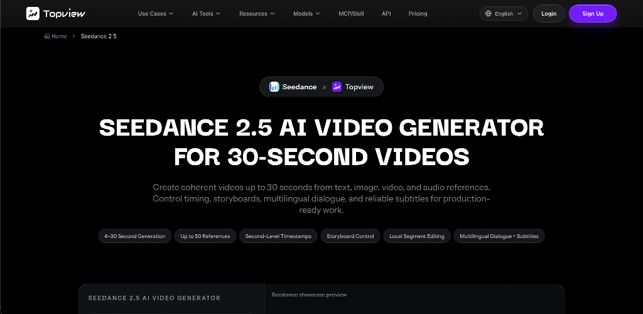
Seedance 2.5, from ByteDance’s Seed line and available to creators through production-facing surfaces such as Topview, is positioned around those jobs: native length toward thirty seconds, dense multimodal referencing, timestamp-minded direction, storyboard-friendly control, and stronger multilingual dialogue or subtitle behavior than short-clip toys typically offer.

Core capabilities that matter for real work

Longer single-pass storytelling

Four-to-thirty-second generation changes the creative brief. A product ad can open on the pack, prove a benefit, move into lifestyle context, and close on a clean hold. A training clip can introduce a concept and demonstrate it without forcing a hard cut every eight seconds. The practical win is fewer timeline seams — provided the prompt is written like a mini shot list, not a mood caption.

Multimodal reference control

Creators can guide identity, SKU detail, motion, and audio with a sizable reference kit (images, short video clips, and audio within supported limits). The operating rule is simple: every asset needs a role. Two conflicting bottle colors or two different “hero faces” still confuse any model. Labeled packs beat vibe folders.

Direction by time and board

Second-level timestamps, contact sheets, keyframes, and previs-style references help teams describe shot order before they spend credits. That is closer to how agencies already work than a blank chat box. Local segment editing also matters: when second twelve invents the wrong label, you want to revise a range, not gamble on a full reroll.

Audiovisual and multilingual delivery

Dialogue, lip sync, and clearer on-screen text support matter for explainers, localized ads, and avatar-led walkthroughs. Sound written into the brief — music pacing, VO placement, what must not appear — usually outperforms “add audio later” habits trained by mute plate generators.

Who gets the most value

Ecommerce and brand marketers — Complete short spots from packshots and campaign references, useful for paid social and product pages.

Content and creative teams — Faster concept films and A/B story tests before a live shoot.

Educators and product teams — Short explainers that need readable structure more than viral gimmicks.

Freelance video producers — Higher throughput on retainer calendars when briefs and brand kits are standardized.

This review stays in clean professional verticals: retail, education, software demos, travel inspiration, food, fashion, and public-interest storytelling. Those are the categories where longer AI video earns trust fastest for brand and publisher workflows.

Strengths

  • Native room for a full short-form arc instead of forced stitching
  • Reference depth suited to commercial continuity pressure
  • Timing and storyboard habits that reward disciplined briefs
  • Fit for ads, explainers, fashion films, and cinematic proof scenes

Limitations to plan around

  • Weak briefs still produce weak thirty-second clips — length amplifies vagueness
  • Conflicting references will fight each other; curation remains a human job
  • Complex multi-character dialogue still needs review before client delivery
  • Commercial licensing and credit costs depend on the platform plan you use

Treat Seedance 2.5 as an execution engine inside a production checklist, not as a replacement for strategy, brand rules, or final QC.

A practical workflow worth copying

  1. Write one objective sentence and four timed blocks.
  2. Upload role-labeled references only.
  3. Prompt with camera verbs, locks, and a short do-not list.
  4. Preview continuity on identity and product readability.
  5. Repair the failing segment, then export for the target aspect ratio.

Teams that follow that order usually spend fewer credits than teams that mash “cinematic luxury viral” into a single line.

Verdict

Next-gen AI video is less about collecting every flashy effect and more about finishing a thought in one controlled generation. Seedance 2.5 stands out when your deliverable needs longer continuity, denser references, and direction that looks like a timeline instead of a lottery ticket.

For small businesses, educators, agencies prototyping campaigns, and creators building serious short-form calendars, it is a strong option in 2026’s longer-clip generation wave — especially if you already think in storyboards, brand kits, and revision discipline. Bring a clear brief. Lock what must stay consistent. Let the model execute the beat. That is how longer AI video stops being a demo and starts being a production asset.

Categories: Tech

Our awards

Discover Our Awards.

See Awards

You Might Also Like