Back to top

When Talent Becomes the Bottleneck: A Lesson in Workforce Strategy from Global Shipping

Every growth strategy rests on an assumption so basic that boards rarely question it: when the business expands, the people…

When Talent Becomes the Bottleneck: A Lesson in Workforce Strategy from Global Shipping

17th July 2026

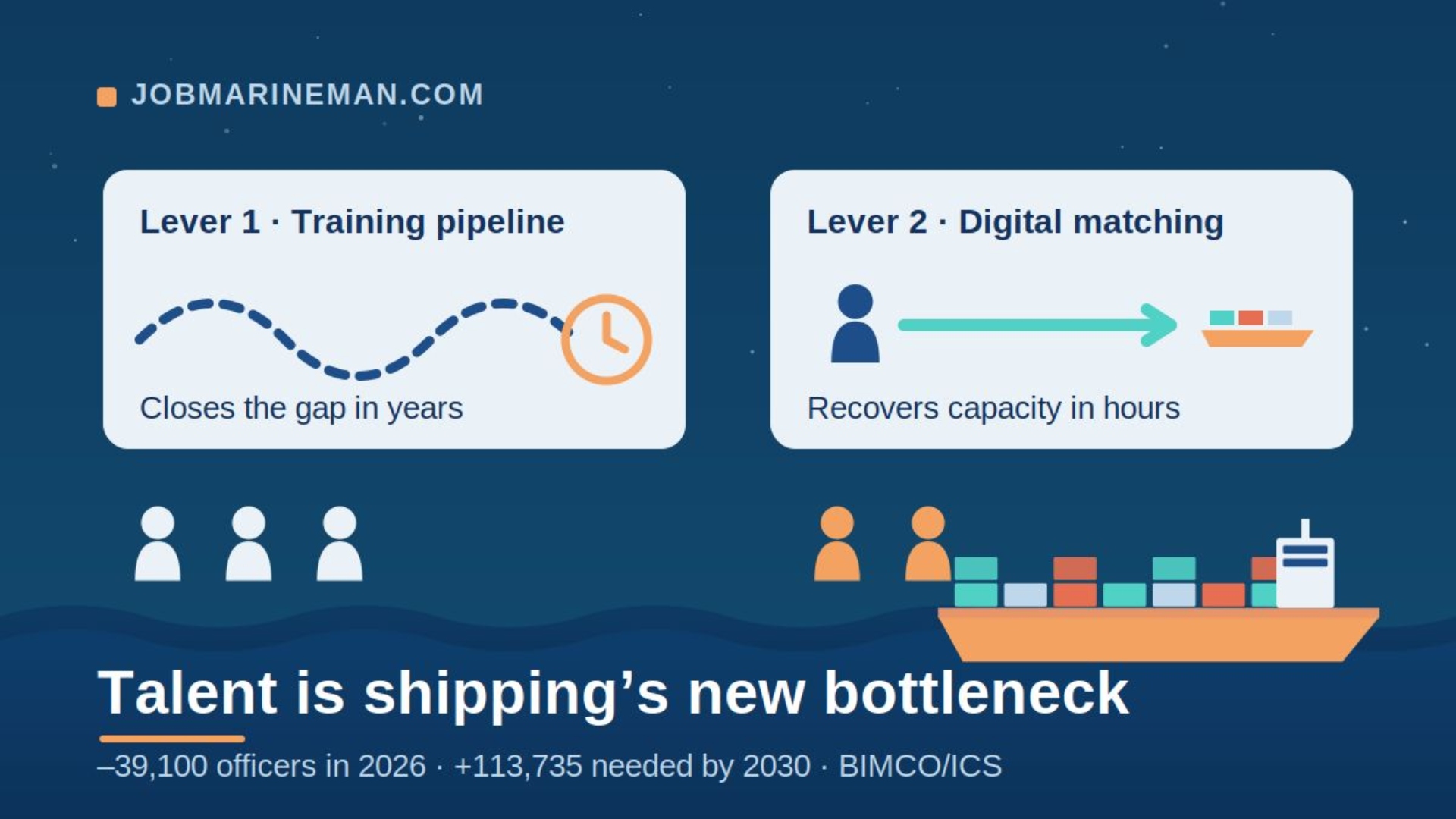
Every growth strategy rests on an assumption so basic that boards rarely question it: when the business expands, the people to run it will be found. Global shipping is now discovering what happens when that assumption breaks. The Seafarer Workforce Report 2026, published in June by BIMCO and the International Chamber of Shipping, puts a number on the problem — the world merchant fleet is short 39,100 certified officers this year, and will require a further 113,735 by 2030. Demand for qualified seafarers has jumped 35% since 2021, outpacing every effort to train replacements.

For an industry of more than 85,000 vessels crewed by 2.57 million people, this is no longer an HR metric. It is a constraint on capacity itself: a ship without a certified chief officer does not sail, no matter how strong the order book looks. Shipping has become a live case study in what management theory calls the binding constraint — and its response offers lessons for any sector where skilled people, not capital, now limit growth.

Two levers, two speeds

The report prescribes investment in maritime education and more effective recruitment. These sound like one agenda; strategically, they are two very different levers. Training expands the pipeline, but it works on a horizon of years — an officer’s licence is earned through academies and accumulated sea time, and no budget can compress that safely. Recruitment efficiency, by contrast, works immediately: every qualified officer who sits idle between contracts while a shipowner elsewhere searches for exactly that rank represents capacity the industry already paid to create and then failed to use.

That second lever — matching — is where technology changes the equation fastest. The traditional crewing market operates through chains of local agencies, where a vacancy can take weeks to reach the right candidate and every intermediary adds cost and opacity. In a market defined by scarcity, that friction is no longer an inconvenience; it is lost revenue.

Closing the matching gap

This is the problem jobmarineman.com was built to solve. The platform, operated by Marine MAN — a Ship and Crew Management company with nearly two decades in the shipping industry — connects vessel operators and seafarers directly, in eleven languages, across a database of roughly 200,000 professional profiles.

For shipowners, it functions as a direct search engine for maritime talent: filtering by rank, certification, vessel type and sea service, contacting verified candidates within hours, and posting vacancies with global reach. Operators who prefer a managed service can hand the entire cycle to the company’s Crew Management team — document verification, MLC-compliant contracts, payroll, travel logistics and rotation planning. For seafarers, registration is free: one professional profile makes them visible to employers worldwide, with direct applications replacing dependence on a single local agency.

The strategic logic mirrors what transparent marketplaces have done elsewhere: when supply and demand can finally see each other, scarce capacity flows to where it is valued most — and employers who pay on time and plan rotations properly win the competition for people.

The wider lesson

Shipping will spend the next decade rebuilding its training pipeline, as it must. But the immediate difference between operators who feel the officer shortage and those who do not will be made by matching — by how quickly and transparently they can reach the workforce that already exists. Leaders in other talent-constrained industries, from energy to engineering, may want to study that distinction before their own hiring assumptions break.

Let’s discuss cooperation

Want to know how our team can help your business?

Contact us: [email protected]

Categories: Logistics

Our awards

Discover Our Awards.

See Awards

You Might Also Like