Back to top

How to Choose a Reliable Cloud Application Development Company for Your Project

Choosing a cloud application development company is no longer a purely technical decision. It directly impacts how your product scales and how…

How to Choose a Reliable Cloud Application Development Company for Your Project

20th April 2026

Choosing a cloud application development company is no longer a purely technical decision. It directly impacts how your product scales and how much you spend maintaining it over time.

Many businesses only recognize this after launch. What works during early development often fails under real user demand. Performance drops and hidden architectural issues begin to surface. That is why selecting the right partner should be treated as a strategic investment rather than a procurement task.

This article explains how to evaluate cloud development vendors, what criteria actually predict long-term success, which red flags to avoid, and how to structure your selection process step by step.

Why Choosing the Right Cloud Development Partner Matters

Cloud systems offer flexibility, but that flexibility introduces risk when handled incorrectly. A poorly designed system may struggle to scale or expose security gaps due to misconfigurations. These problems rarely appear at the beginning. They emerge gradually as the product grows and becomes more complex.

Think about a situation where your SaaS development partner has helped you create a Minimum Viable Product (MVP) as a startup, using a basic cloud setup to maximize your budget and save time. As user demand increases, your application slows. At the same time, your infrastructure costs rise because scaling has not been done correctly. Instead of optimizing, your development team will have to rebuild major portions of the application. As a result, your overall budget will be exceeded, and your growth will be delayed.

A reputable cloud application development partner will avoid this situation by planning for your growth from day one. A good developer will build a scalable application in the cloud and create a predictable infrastructure plan that can continue supporting you as your product grows.

What to Look for in a Reliable Cloud Application Development Company

You will have an easier time choosing a vendor when you move beyond assumptions and evaluate companies against clear criteria. At this stage, the goal is not only to compare pricing but to understand how each vendor approaches architecture, delivery, and long-term product growth.

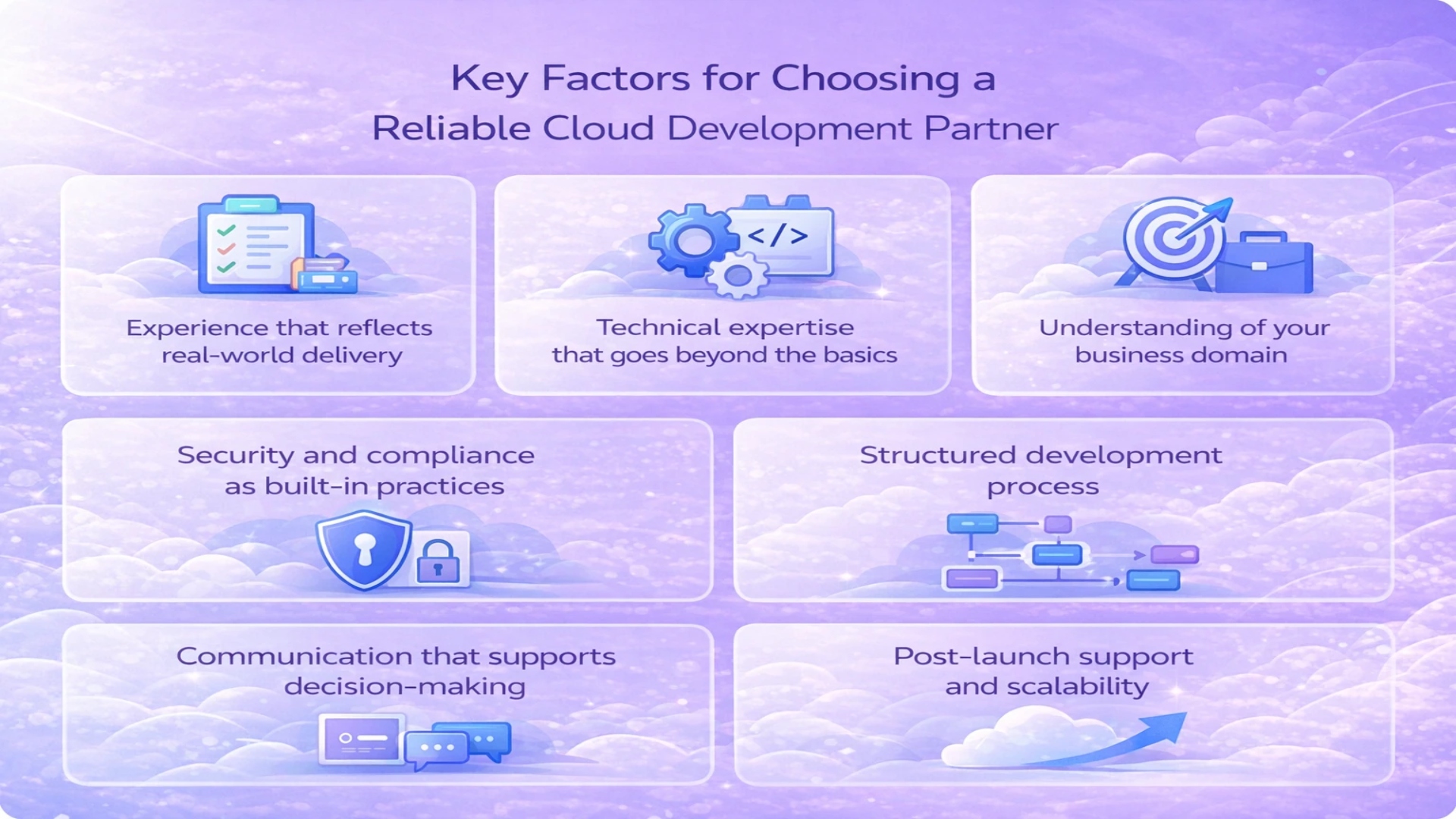
Experience that reflects real-world delivery

The strongest indicator of capability is proven delivery. A vendor should be able to demonstrate cloud software development services through completed projects that went beyond the MVP stage and were used in real-world settings.

Case studies should explain not only what was built but also the outcomes achieved. This helps you assess whether the team can manage complexity comparable to your own product.

Technical expertise that goes beyond the basics

Cloud expertise is not limited to deployment. A capable cloud app development company understands how to design cloud-native application development solutions using modern approaches such as microservices and automated delivery pipelines. They also know when to use serverless models and when a more traditional architecture is required.

Strong experience with AWS or Google Cloud enables you to choose the right infrastructure for your needs.

Understanding of your business domain

Every industry introduces its own constraints. A healthcare product requires strict data protection. A fintech platform needs secure transaction handling. A logistics system depends on integrations and real-time processing.

A vendor with domain experience understands these requirements early. This reduces misalignment and supports faster, more accurate decision-making throughout the project.

Security and compliance as built-in practices

Today, security incorporated into the design of all systems is required for businesses. Trusted cloud infrastructure service providers design network and server architectures with either segregation or multi-tenancy in mind, and develop all offerings in compliance with legal requirements such as GDPR and industry-specific best practices. Companies that take these preventive measures significantly reduce their audit risk and further support their ability to expand globally, with virtually no duplication of effort.

Communication that supports decision-making

Project success is often determined by clear communication. Partners who can articulate technical decision-making clearly and highlight risks as they arise will be most successful. For example, business stakeholders who lack technical expertise rely heavily on clarity in the decision-making process rather than on understanding everything in depth.

Structured development process

Speed alone does not matter most. The delivery of an application or service is most important, as consistent delivery indicates a reliable vendor that uses structured methods such as Agile methodologies and automated testing.

Post-launch support and scalability

Cloud systems continue to develop after they are released. Responsible vendors will plan to monitor and scale their systems from the very beginning and be proactive in ensuring they remain stable as usage grows. Vendors need the ability to adjust their infrastructure in response to actual demand to ensure they provide a scalable enterprise cloud solution and product.

Red Flags to Avoid

Certain warning signs are visible before any contract is signed. Ignoring them often leads to delays or unstable systems after launch.

Lack of relevant case studies

Limited real-world experience is recommended when a vendor does not have projects similar to yours. Generic portfolios that do not clearly indicate the outcome or demonstrate measurable impact also create uncertainty about the team’s ability to manage your product’s complexity.

Unrealistically low pricing

When estimating costs for building in the cloud, several items are often underestimated or omitted, including architectural/technical design, as well as security-related design/implementation. The omission of these critical elements usually leads to either additional budget exposure as the project progresses or expensive rework needed to get things working correctly once they have launched.

Poor communication in the early stages

Communication problems tend to start early and continue throughout your project. When a vendor gives unclear answers or can’t articulate how they will approach something, collaboration becomes more difficult, and over time, the opportunities for mutual understanding and transparency begin to compound.

No structured development process

Without a defined vendor workflow, you cannot anticipate their delivery. When you cannot explain to us how you intend to plan, build, test, and release software, your project is at risk of stoppage and ambiguous progress.

Vague timelines and commitments

If timelines are hard to interpret or overly optimistic, they often reflect inadequate planning. Vendors with reliable track records set milestones and divide their work into phases to make completion easier. Unclear timelines usually indicate either uncertainty about how something is being done or difficulties completing that phase.

No clear post-launch support plan

Applications built on cloud platforms require continuous monitoring and scaling. When a vendor does not establish their responsibilities for ongoing support before you begin, there is a chance that, as your usage increases, the application will become unstable. By identifying the five red flags above as soon as possible, you can minimize your risks when choosing a cloud application development company that can continue to support your application.

Step-by-Step Vendor Selection Process

Once you understand what separates a reliable vendor from a risky one, the next step is to apply a structured selection process. This helps you compare companies objectively and reduces the risk of choosing solely on price.

1. Research

Start with broad market research to identify companies that match your project type, whether it involves custom cloud solutions or building a new SaaS platform.

Review websites and client feedback to understand their experience with cloud consulting services and delivery capabilities.

2. Shortlisting

Limit your candidate selection to 3 to 5 vendors that best align with your requirements. The key to this is to select vendors with diverse areas of expertise. For example, one vendor may have extensive experience building cloud-based applications, while another may excel at enterprise-level cloud-based solutions and integrations.

3. Interviews

Determine how each vendor solves problems through interviews. Assess their knowledge of your product goals and their method for working together. If you have a solid communications foundation at this phase, it will typically lead to easier implementation down the road.

4. Technical evaluation

Assess how the vendor would design and support your solution. Review their approach to architecture, scalability, DevOps, testing, and cloud infrastructure services. If needed, involve a technical advisor to validate their recommendations. This step is critical for identifying potential risks before development begins.

5. Pilot project

For complex or high-risk projects, start with a smaller engagement such as a discovery phase or technical audit. This allows you to evaluate collaboration and alignment before committing to full-scale development.

Conclusion

Choosing a cloud application development company shapes the future of your product far beyond initial delivery. The right partner helps you build scalable cloud applications and support long-term growth. The wrong choice often leads to instability and repeated rework.

A structured evaluation process, combined with clear communication and validation through real interaction, reduces uncertainty and improves outcomes. In cloud development, long-term thinking consistently delivers better results than short-term savings.

Categories: Tech

Our awards

Discover Our Awards.

See Awards

You Might Also Like